

Wearable devices generate unique challenges for radio communications. Radio solutions are designed for the “default case” of the RF component sitting on a PCB, mounted in a plastic box, with an air gap around the PCB, and an optimised keep out zone and ground plane. This is logical for an all-purpose design, but not for the typical wearable case, where the RF component is near the body, a strong absorber of microwave radiation, and space is at a premium. This article examines the challenges of RF wearable design and how to overcome them.

Use-Case Analysis
The first action is to analyse and define the use-case and the overall solution architecture,
- What will the wearable communicate with and when?
- What throughput/data rate is required
- Is near continuous connection required, or in case of interrupt, is “store and forward”, or a simple break in data continuity acceptable?
From this, one can define the worst-case scenario to be supported – in terms of the position of the wearable and the device it connects to and any possible obstruction including the body of the wearer and the data rate necessary to achieve the usage objective. It is different if the connection is just used to configure a device, in which case, one can assume the two objects will be close to each other and largely unobstructed, as opposed to a wearable in continuous contact, where a device might have most of the body between it and the phone some distance away.
Wearable devices typically use Bluetooth to communicate, although they can include a GPS receiver and/or long-range radios such as a cellular or LoRa connection. For this article we assume we are using a Bluetooth type radio. However the RF issues are the same for other 2.4GHz protocols such as ANT+, WiFi, or proprietary ones, and similar at 5Ghz.
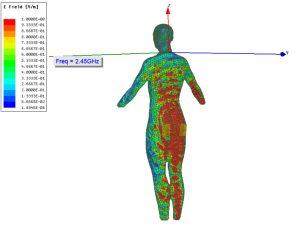
The 2.4 GHz frequency of Bluetooth is one easily absorbed by the human body, having the properties of water. Our studies show that a device held one side of the body will be attenuated by 60 to 80 dB relative to a device on the other side, emphasizing that the positioning of the wearable and receiving device is crucial.
Physical design choices
The key physical design issues for a devicefrom a radio perspective are:
Materials used in the housing
- Battery placement
- Placement of the radio component and PCB within the device
- Antenna choice/design
Technical considerations may drive design in a different direction to aesthetic ones. For materials, the ideal is some RF transparent material such as polymeric plastic eg ABS, Perspex. Conversely conductive metal will be a highly negative choice. It is possible to use some metal, with an “RF window” for radiation to escape, but performance will be degraded.
The battery is important for the RF design and is typically metal cased. Ideally, it would be placed to the side of the PCB containing the RF component, with the antenna separated as far as possible. As such the battery can form part of the ground plane for the RF solution. Underneath the RF component is far less favourable and should be separated vertically by as much distance as possible.
The PCB placement is also critical due to the body’s absorption of RF radiation. Achieving the maximum distance between the body and the RF component, specifically the antenna, is crucial.
A separation of ¼ λ – which at 2.4GHz equates to 3 x 10⁸ / 4 x 2.4 x 109 = ~ 3cm would be optimum. This might not be possible in but nevertheless our extensive simulations show that at 2mm spacing from the body the antenna gain away from the body is close to -2 dBi, increasing to 0dBi at 3 to 4 mm.
Finally, antenna choice is vital.. Antenna performance will be enhanced with a large antenna, whilst wearables aim to be small and convenient to wear.
There are three main options for the antenna, listed in increasing order of complexity.
- Use a module with integrated antenna
- Connect an antenna part to the RF circuit
- Design a custom antenna as part of the wearable
The first option is the easiest, minimising design effort and risk. It also – for a certified module – removes the requirement to engage in lengthy and expensive certification efforts such as CE, FCC and Bluetooth SiG.
We only recommend either of the other two options for experienced RF designers. An RF reference design may look relatively easy. In reality it is easy to get wrong. With wearables, where one is already battling a difficult environment, it may result in a poorly functioning device, or multiple development cycles, and problems with certification.
The possible upside of a custom antenna design is that it can be optimised with respect to the overall design of the device, provided the design can be truly optimised. This is not a process with straightforward rules, and is best considered when performance is critical. It requires skilled RF designers working as key part of the design team and can be a time-consuming and costly exercise.
For most scenarios, there are miniature solutions available, small enough to work in most wearables and give good performance which will be difficult to improve on. Further details of Insight SIP’s miniature Bluetooth products are available here.
RF component placement
The problem is then reduced to placement of the RF component. Normally the module manufacturer will recommend a “keep out” zone around the antenna portion. However, this might be hard to achieve in a space-constrained wearable. Again, there is a trade off between size and performance.
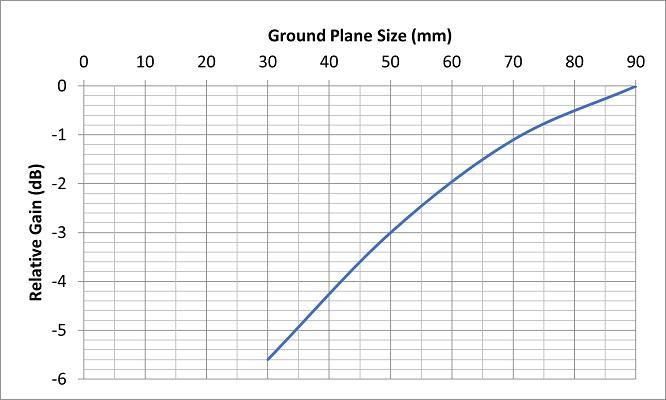
Typically, any small antenna will work best with a metal plane, called a “ground plane”, that has at least one dimension close to a quarter wavelength (3cm at 2.5 GHz). This is often possible for devices operating in the 2.4 GHz ISM band but can be difficult in the case of sub Gigahertz communications. For the 868MHz ISM band (Zigbee, LoRa or Sigfox) this would translate to a minimum size of 9cm, large for a wearable. Our simulations show that antenna gain and hence “link budget” will decrease with decreasing ground plane dimension:
SAR Regulations
A further problem for designers of wearables is that in addition to standard regulations (FCC, CE etc) relating to radio products, additional rules apply for devices worn close to the body. These are called Specific Absorption of Radiation (or SAR) rules, which for health and safety reasons, limit the radiation that can be absorbed by the human body.
These regulations are complex, and vary by country, and can be frequency dependent. However, by way of example, we will look at the FCC regulations, (amongst the most stringent, for a Bluetooth frequency device. The rules can also vary depending on where on the body the device is to be placed – devices on the extremities such as the arm, away from major organs, have less stringent regulations than those placed on the head and body core, where major organs are. There also can be a distinction between “uncontrolled” and “occupational” use, with stricter rules for devices sold to the public as opposed to those used exclusively by trained personnel.
However, a typical mass market wearable is required to have a power density of less than 1mW/cm2. Moreover, this is a time averaged figure, and a Bluetooth radio, or even a WiFi one, is not typically constantly transmitting. Therefore, in practice, most wearables are not likely to exceed the SAR limits in normal usage. What can be more difficult is demonstrating this conclusively. The net result is that for most wearables, some SAR testing is likely to be required. There are many certification labs offering this kind of service, where the device is placed next to a model simulating a human body, and the radiation can be measured inside this body.
Conclusions
It is perfectly possible to design a radio based wearable device that functions well. However, careful design is required to ensure that the performance is as good as it can be, although some degradation through proximity to the body is inevitable. Additionally, to be sold globally, a device must conform to both general radio regulations and SAR rules for each territory in which it is to be sold.
This article is an extended version of one first published in Electronics Specifier (see p42)